A group is any set G with a defined binary operation (called the group law of $G$), written as 2 tuple (examples: $(G,*), (G,\cdot), (G,+), …$), satisfying 4 basic rules
Closure
The important point to be understood about a binary operation on $G$ is that $G$ is closed with respect to $*$ in the sense that if $a,b\in G$ then $a*b\in G$
($$a,b\in{C}$$ can be read as “a,b element of C” or “a,b in C“)
Associativity
$$(a*b)*c = a*(b*c), \forall a,b,c\in{G}$$
($$\forall{a,b}\in{C}$$ can be read as “for all a,b in C” or “for all a,b being element of C” or “for each a,b in C” or “for every a,b in C“, … etc.)
Identity
An element $$e\in G$$ (called identity of the Group $$G$$) that satisfies the condition $$e*a=a*e = a, \forall a\in{G}$$
$$G$$ contains at most one identity element $$e$$
Inverse
$$\forall a\in{G}$$ there exists an element $$a^{-1}\in{G}$$ such that $$a*a^{-1} = a^{-1}*a = e$$
Groups can be both finite and infinite.
Some Examples of Group
Example 1
The set $$\mathbb{R}\backslash\{0\}$$ (set of all real numbers excluding $$0$$) with the binary operation of multiplication $$((G,*))$$ forms a group.
closure criteria
$$\forall a,b\in \mathbb{R}\backslash\{0\} \implies a*b\in \mathbb{R}\backslash\{0\}$$
For instance,
5*6 =30 is an element of $$R\backslash\{0\}$$
associativity criteria
$$\forall a,b\in \mathbb{R}\backslash\{0\} \implies a*(b*c)= (a*b)*c=a*b*c$$
For instance,
2*(3*9)=(2*3)*9 = 2*3*9=54
identity Criteria
number $$1$$ is identity for $$*$$ in $$\mathbb{R}\backslash\{0\}$$
$$\forall a\in \mathbb{R}\backslash\{0\}, a*1=1*a=a$$
For instance,
1*5=5*1=5
inverse criteria
$$\forall a\in \mathbb{R}\backslash\{0\} \implies a*a^{-1}=1$$
For instance,
$$2*\frac{1}{2}=2*0.5=1$$
Example 2
The set $$\mathbb{R}$$ with the binary operation of addition $$((G,+))$$ forms another group
closure criteria
$$\forall a,b\in \mathbb{R} \implies a+b\in \mathbb{R}$$
For instance,
5+6 =11 is an element of $$\mathbb{R}$$
associativity criteria
$$\forall a,b\in \mathbb{R} \implies a+(b+c)= (a+b)+c=a+b+c$$
For instance,
2+(3+9)=(2+3)+9 = 2+3+9=14
identity Criteria
number $$0$$ is identity for $$+$$ in $$\mathbb{R}$$
$$\forall a\in \mathbb{R}, a+0=0+a=a$$
For instance,
0+5=5+0=5
inverse criteria
$$\forall a\in \mathbb{R}\implies a+a^{-1}=0$$
For instance,
$$2+2^{-1}=2+(-2)=0$$
Subgroup
Given a group $$G$$ under a binary operation $$*$$, a subset $$H$$ of $$G$$ is called a subgroup of $$G$$ if $$H$$ also forms a group under the operation $$*$$
Both Group($$G$$) and Subgroup($$H$$) share the same identity $$e$$.
Group Table
Group table describes the structure of a finite group by arranging all the possible products of all the group’s elements in a square table (reminiscent of an addition or multiplication table). Many properties of a group – such as whether or not it is abelian, which elements are inverses of which elements, and the size and contents of the group – can be discovered from group table
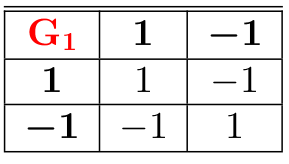
For group $$G_1=\{1,-1\}$$ the multiplication table $$((G_1,*))$$ looks like:
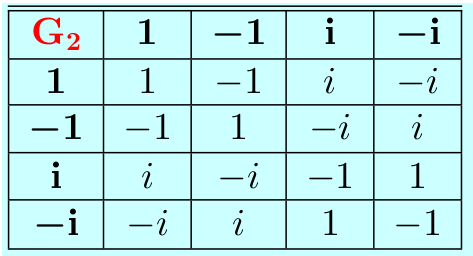
For group $$G_2 = \{1, -1, i, -i\}$$, the multiplication table $$((G_2,*))$$ looks like:
Homomorphism of a Group
if $$G$$ and $$H$$ are two groups with binary operations $$*$$ and $$\circ$$, respectively, a function $$f:G\rightarrow{H}$$ is a homomorphism if
$$f(a*b)= f(a)\circ{f(b)}$$, $$\forall a,b \in{G}$$
Simply put, group homomorphism is a transformation of one Group into another that preserves (invariant) in the second Group the relations between elements of the first.
Examples of Group Homomorphism
Example 1
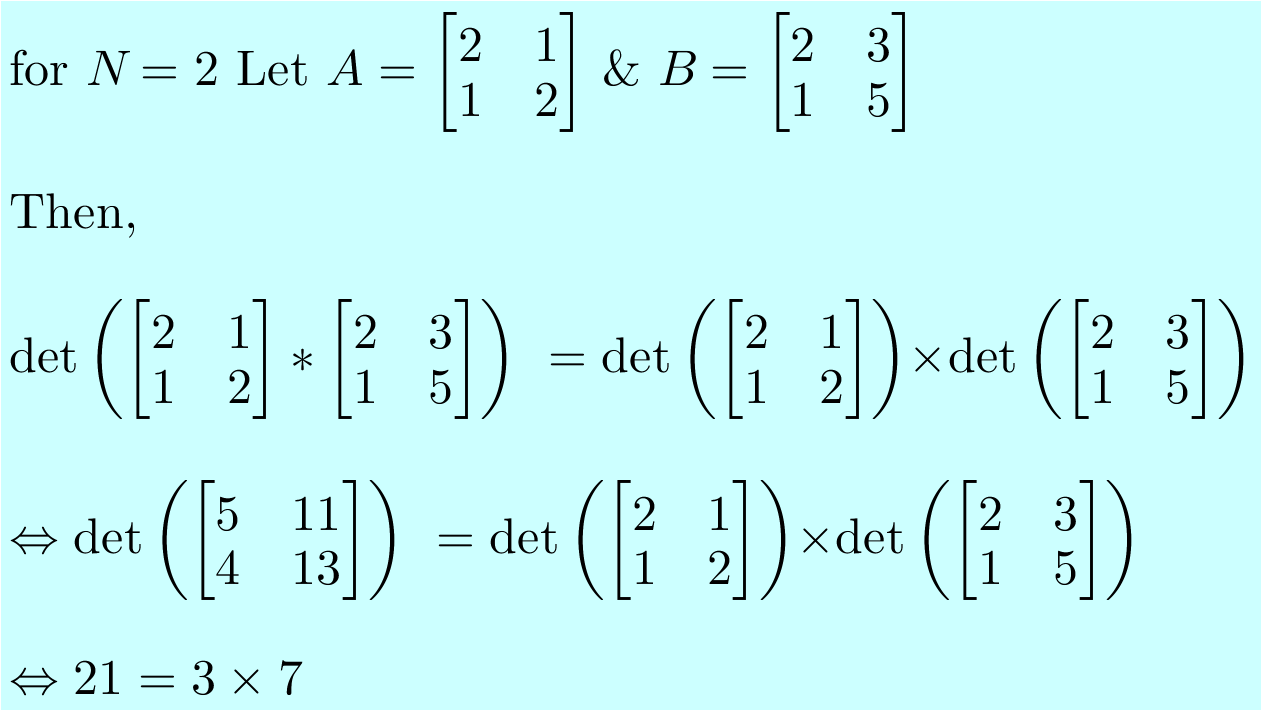
Let $$G$$ be the group of all nonsingular, real, $$N\times{N}$$ matrices with the binary operation of matrix multiplication. Let $$H$$ be the group $$\mathbb{R} \backslash\{0\}$$ with the binary operation of scalar multiplication. The function that is the determinant of a matrix is then a homomorphism from $$G$$ to $$H$$
To put this in symbolic context:
Let $$(G=\{A,B,C,D,…\},*)$$ and let $$(H=\mathbb{R}\backslash{\{0\}},\times)$$
Then, $$\det(A*B)=\det(A)\times\det(B)$$
Endomorphism
A homomorphism $$f:G \rightarrow{G}$$ is called an endomorphism
Examples of Endomorphism
Example 1
Let $$G$$ be the group $$\mathbb{R}\backslash\{0\}$$ with the binary operation of multiplication. The function that takes the absolute value of a number is then an endomorphism of $$G$$ into $$G$$
To put this in symbolic context:
Let $$(G,*)$$, $$G=\mathbb{R}\backslash\{0\}$$ Then,
$$|x*y|=|x|*|y|$$, $$\forall x,y\in{G}$$
For instance,
|-3*4|=|-3|*|4|=3*4=12
And
|-2| = |2|=2
Isomorphism
A homomorphism $$f :G \rightarrow H$$ is an isomorphism if $$f$$ is both one-to-one and onto (bijective).
Examples of Isomorphism
Example 1
Let $$G$$ be the group of positive real numbers with the binary operation of multiplication and let $$H$$ be the group of real numbers with the binary operation of addition. The $$\log_b$$ function is an isomorphism between $$G$$ and $$H$$
To put this in symbolic context:
Let $$(G,*)$$, $$G ={\{\mathbb{R}^+\}}$$ and Let $$(H,+)$$, $$H={\{\mathbb{R}\}}$$,
Then,
$$\log_{b}(x*y) = \log_{b}(x) + \log_{b}(y)$$, $$\forall x,y\in{G}$$
($$\mathbb{R}^+$$ denotes set of all positive real numbers)
Automorphism
An isomorphism $$f:G \rightarrow{G}$$ is called an automorphism.
Examples of Automorphism
Example 1
Let $$G$$ be the group $$\mathbb{R}^+\backslash\{0\}$$ with the binary operation of multiplication. The function that takes the absolute value of a number is then an automorphism of $$G$$ into $$G$$
To put this in symbolic context:
Let $$(G,*)$$, $$G=\mathbb{R}^+\backslash\{0\}$$, Then, $$|x*y|=|x|*|y|$$, $$\forall x,y\in{G}$$
For instance,
[3*4|=|3|*|4|=3*4=12
In this case both sides can use only positive real numbers. Note that this contrasts with an earlier example of Endomorphism where the Group $$G=\mathbb{R}\backslash\{0\}$$
Kernel of Homomorphism
The kernel of a homomorphism $$f:G \rightarrow{H}$$ is the subgroup $$f^{-1}(e_0)$$ of $$G$$.
In other words, the kernel of $$f$$ is the set of elements of $$G$$ that are mapped by $$f$$ to the identity element $$e_0$$ of $$H$$
The notation $$K(f)$$ can be used to denote the kernel of $$f$$
Examples of Kernel of homomorphism
Example 1
Let $$G$$ be the group of all nonsingular, real, $$N \times N$$ matrices with the binary operation of matrix multiplication. Let $$H$$ be the group $$\mathbb{R}\backslash\{0\}$$ with the binary operation of scalar multiplication. The function that is the determinant of a matrix is then a homomorphism from $$G$$ to $$H$$
Let $$(G=\{A,B,C,D,…\},*)$$ and let $$(H=\mathbb{R}\backslash{\{0\}},\times)$$
Then,
$$\det(A*B)=\det(A)\times\det(B)$$
In this case the kernel of $$\det$$ consists of set of all $$N \times N$$ matrices with determinant equal to the real number $$1$$
Example 2
Let $$(G,*)$$, $$G=\mathbb{R}\backslash\{0\}$$, Then,
$$|x*y|=|x|*|y|$$, $$\forall x,y\in{G}$$
The kernel of $$|a|, \forall{a}\in{G}$$ consists of set $$\{-1,1\}$$
Example 3
Let $$(G,*)$$, $$G=\mathbb{R}^+\backslash\{0\}$$, Then,
$$|x*y|=|x|*|y|$$, $$\forall x,y\in{G}$$
The kernel of $$|a|, \forall{a}\in{G}$$ consists of set $$\{1\}$$
Example 4
Let $$(G,*)$$, $$G ={\{\mathbb{R}^+\}}$$ and Let $$(H,+)$$, $$H={\{\mathbb{R}\}}$$
Then,
$$\log_{b}(x*y) = \log_{b}(x) + \log_{b}(y)$$, $$\forall x,y\in{G}$$
The kernel of $$\log_b$$ is the set $$\{1\}$$ because identity $$0$$ of $$H$$ is mapped to set of all numbers whose $$\log_b$$ produces $$0$$
Some simplified theorems derived from homomorphism
(Note: I will not provide any proofs here, because the theorems are quiet simple and proofs can be worked out easily)
Theorem 1
If $$f:G \rightarrow{H}$$ is a homomorphism, then $$f(e)$$ coincides with the identity element $$e_0$$ of $$H$$ and $$f(a^{-1}) = f(a)^{-1}$$
Example for Theorem 1
Let $$G$$ be the group of all nonsingular, real, $$N\times{N}$$ matrices with the binary operation of matrix multiplication. Let $$H$$ be the group $$\mathbb{R} \backslash\{0\}$$ with the binary operation of scalar multiplication. The function that is the determinant of a matrix is then a homomorphism from $$G$$ to $$H$$
To put this in symbolic context:
Let $$(G=\{A,B,C,D,…\},*)$$ and let $$(H=\mathbb{R}\backslash{\{0\}},\times)$$
Then, $$\det(A*B)=\det(A)\times\det(B)$$
In this case the identity of Matrix is the Identity matrix (denoted by $$I$$).
Therefore, $$\det(I*B)= \det(I)\times \det(B)$$, where: $$\det(I) =1$$ and $$1$$ is identity of $$\mathbb{R}\backslash\{0\}$$
Now For $$N=2$$, Let $$A = \left[\begin{matrix}2 & 1 \\1 & 2\end{matrix}\right]$$
Then,
$$\det(A)=3$$ & $$\det(A)^{-1}=\frac{1}{3}$$
$$A^{-1} = \left[\begin{matrix}\frac{2}{3} & -\frac{1}{3} \\-\frac{1}{3} & \frac{2}{3}\end{matrix}\right]$$
$$\det(A^{-1})=\frac{3}{9}=\frac{1}{3}$$
We can verify that, $$\det(A^{-1})=\det(A)^{-1}$$
Theorem 2
If $$f:G\rightarrow{H}$$ is a homomorphism and if $$G’$$ is a subgroup of $$G$$, then $$f(G’)$$ is a subgroup of H
Theorem 3
If $$f:G\rightarrow{H}$$ is a homomorphism and if $$H’$$ is a subgroup of $$H$$ , then the preimage $$f^{-1}(H’)$$ is a subgroup of $$G$$
Theorem 4
A homomorphism $$f:G\rightarrow{H}$$ is one-to-one if and only if $$K(f) = {e}$$.
Theorem 5
If $$f:G\rightarrow{H}$$ is an isomorphism, then $$f^{-1}:H\rightarrow{G}$$ is an isomorphism
Theorem 6
A homomorphism $$f:G\rightarrow{H}$$ is an isomorphism if it is onto and if its kernel contains only the identity element of G.